Marketing that clears SEBI, RBI and IRDAI compliance before it ships - not after a rejection. Anchored by a live JM Financial partnership.
4.9/5(100+ Reviews)
Trusted by
/ Our Approach
Growing BFSI brands since 2017.
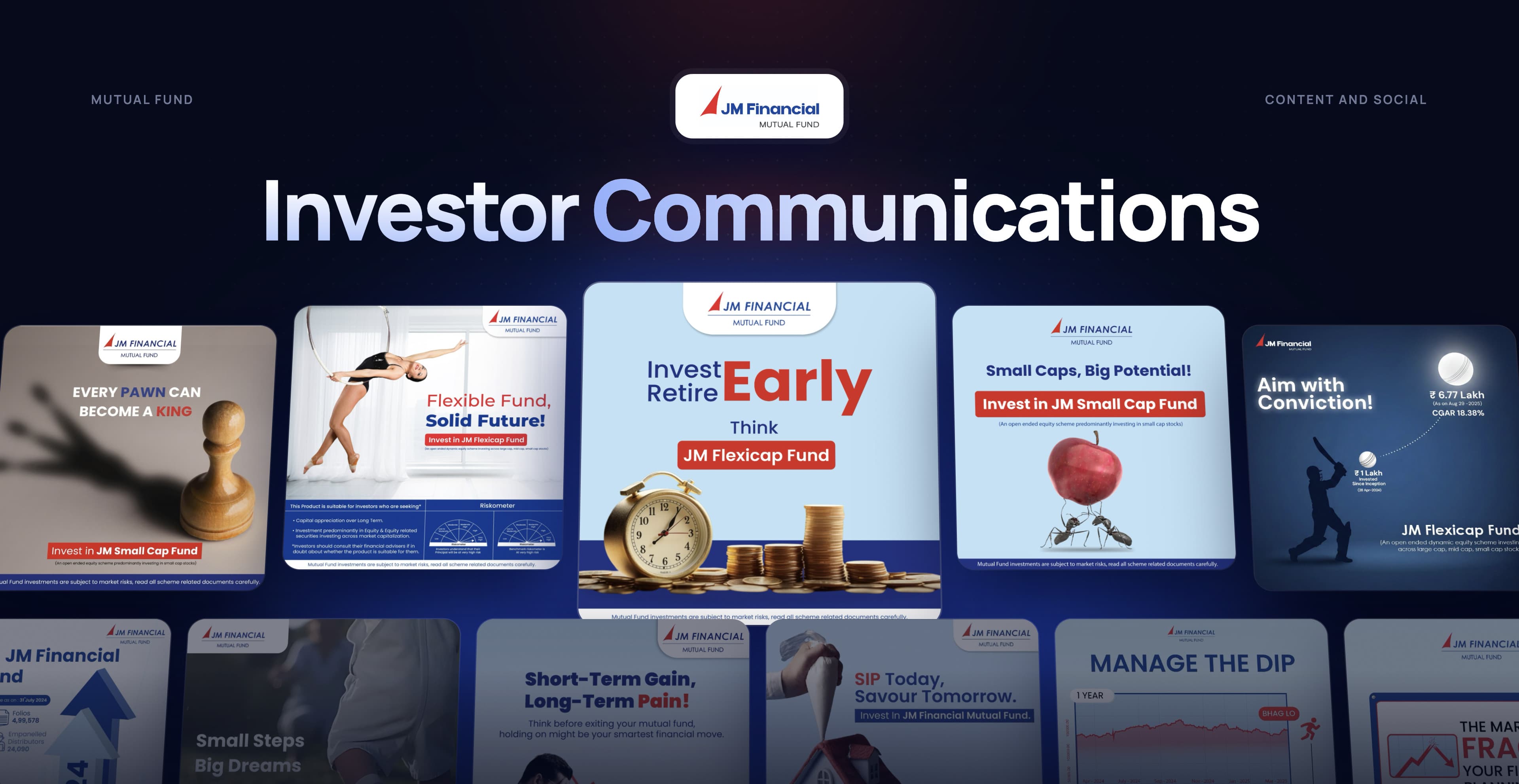
BFSI marketing in India is a compliance problem before it is a creative problem. Every mutual fund ad carries the SEBI-mandated 'Mutual fund investments are subject to market risks' disclosure. Every NBFC loan creative answers to the RBI advertising code on truthful interest-rate claims. Every insurance piece needs IRDAI disclosures on premium, commission and lapsation. Every lead-gen form is now under the DPDP Act, 2023. Most agencies pitch BFSI brands with a D2C deck and discover the gatekeeping only when Legal rejects the first creative - three weeks into a retainer. Baclinc is a Mumbai-based digital agency (founded 2017 by Shalmali Parkar and Abhishek Yadav, 25+ team, 150+ clients, ₹50Cr+ ad spends managed) and our BFSI track record is anchored in a live partnership with JM Financial Mutual Fund - one of India's established mutual fund houses and a part of the JM Financial Group. We handle social media marketing and investor-facing content for JM Financial Mutual Fund: NAV-driven posts, investor-education long-form, seasonal campaign creative, and the review-loop with their Product, Marketing and Compliance teams. That partnership is why this page exists as a genuine BFSI hub rather than a category pitch. Our differentiator is not a deeper funnel than a performance shop - it is creative velocity inside the compliance ceiling. We ship 30-60 compliance-approved assets a month across mutual fund, NBFC, insurance and fintech work, and we design our brief-to-approval workflow around how BFSI Legal teams actually read a creative. If your last agency lost a campaign to a 48-hour rejection cycle, this is what fixed ours. Below, we split BFSI into the four sub-verticals we'll staff differently - mutual funds, NBFCs, insurance and fintech - because the compliance stack, buying cycle and creative grammar of each is distinct enough that a single playbook does not hold.
India's BFSI digital opportunity is larger than the spend maps suggest. Mutual fund AUM crossed ₹60 lakh crore in 2024 and SIP book is at record highs; personal-loan origination through NBFCs has doubled since 2020; UPI volumes routinely cross 16Bn transactions a month; and life and general insurance premiums keep compounding even as penetration remains low. Every one of those flows runs through a digital funnel today - apps, websites, YouTube, Meta, Google Search and a growing pile of WhatsApp + SMS outreach. The catch is the compliance ceiling. SEBI regulates mutual fund communication: the market-risks disclosure is mandatory on every ad, scheme performance claims are tightly controlled, and the Advertisement Code for mutual funds prescribes how returns, comparisons and risk can be shown. RBI's advertising code binds banks and NBFCs - no misleading interest rates, APR disclosure, no hidden-fee language. IRDAI regulates insurance advertising, requiring disclosures on commission, premium, lapsation and exclusions. The DPDP Act, 2023 sits on top of all of it, governing how BFSI brands collect, store and process personal data from lead-gen forms and apps. What breaks at scale for BFSI marketers is predictable. First, regulatory rejection cycles - a creative brief that doesn't pre-empt Legal's questions burns 2-3 weeks and kills a campaign's flighting window. Second, lead quality - performance-only shops optimise to CPL and deliver a pipeline that never converts because the sales cycle is 60-180 days and the lead never had real intent. Third, long sales cycles - a personal loan, a term plan, or an SIP enrolment is a considered decision, and creative that behaves like a D2C impulse ad underperforms on every real metric (activation, persistency, AUM retention). Baclinc's JM Financial Mutual Fund partnership shapes how we set up every BFSI engagement. We start with a compliance-stakeholder map - identifying Product, Marketing, Legal and Compliance reviewers on day one - and write briefs that anticipate the review questions rather than react to them. We build creative pods that hold pre-cleared templates per format (Reel, carousel, static, long-form article, landing-page block), so every weekly push starts 60% compliance-done. We report on business metrics (AUM growth, SIP count, persistency, loan-book, policies-in-force) alongside the paid-funnel metrics, because that's how BFSI CMOs actually have to justify spend internally. We'll also be honest about where we don't play. Baclinc is not a performance-marketing-only BFSI shop - our strongest BFSI offer is SMM + content + AEO/SEO with compliance wrapping around the creative engine. If your brief is pure last-click lead-gen at scale with no content or brand layer, a specialist performance shop will probably serve you better. If you want the content, social and SEO layer that makes your paid spend compound, and you need it to pass SEBI, RBI or IRDAI gatekeeping on the first review, that is the shape of work we do.
SEBI, RBI and IRDAI guardrails are baked into our brief, not bolted on after rejection. Every mutual fund piece carries the market-risks disclosure, every NBFC ad states APR truthfully, every insurance creative carries the IRDAI-mandated disclosures on premium, commission and exclusions. We write to pass Legal on the first review, not the third.
JM Financial Partnership Shapes Our Process
Our live SMM and content partnership with JM Financial Mutual Fund taught us how a real AMC's Product + Marketing + Compliance review cycle works. Our brief templates, version-control workflow, and turnaround SLAs are all built from inside that engagement - not from a theoretical BFSI playbook.
Investor-Education Long-Form Engine
BFSI buyers research before they buy. We run a content engine purpose-built for 'how to choose a mutual fund', 'what is a personal loan APR', 'term vs. whole life insurance' intent - long-form, SEO-mapped, and cleared for regulatory accuracy. That compounding SEO layer is usually what makes the paid math work.
CAC Economics Calibrated for Financial Products
BFSI sales cycles are 30-180 days, not 3 days. We measure lead-to-booking, not lead-to-form-fill, and report AUM growth, SIP additions, loan-book additions or policies-in-force as the actual ROI number. Anyone quoting ROAS on a mutual fund campaign is selling you the wrong scoreboard.
Multi-Language Hindi + English + Marathi Readiness
Indian BFSI is a multi-lingual acquisition problem - tier-2 investor growth runs through Hindi and Marathi creative, not only English. Our content team ships trans-created (not machine-translated) versions with compliance-verified copy in each language from day one.
Honest About Where We Don't Play
We're not a pure performance-marketing shop for BFSI. If you need a last-click-ROAS-optimised loan lead-gen machine at ₹50L/month with no content layer, we're not the right partner. Our strength is the SMM + content + AEO/SEO stack that wraps around compliant paid - which is exactly the shape of our JM Financial work.
/ Specialised Practices
BFSI is not one market.
Each sub-vertical has its own buyer, its own compliance ceiling, and its own playbook.
Mutual Fund Marketing Services
Our mutual fund marketing practice is anchored by a live partnership with JM Financial Mutual Fund - one of India's established AMCs and part of the JM Financial Group. We handle their social media marketing and investor-facing content, which means we've shipped thousands of SEBI-compliant creatives through a real AMC's Product + Marketing + Compliance review cycle. That engagement is not a case study we dressed up for this page; it is the operating system our mutual fund marketing company offer runs on.
The SEBI disclosure framework is the first constraint, not the last. Every creative - Reel, carousel, static, long-form article, landing-page block - carries the 'Mutual fund investments are subject to market risks' disclosure in the prescribed legible form. Performance and return claims follow the SEBI Advertisement Code for mutual funds: the correct period, the correct benchmark, and the prescribed methodology for presenting CAGR and absolute returns. Comparative claims against other schemes or asset classes are either avoided or referenced with explicit source and period. We write to pass your Compliance Officer on the first review by pre-empting the questions they always ask.
Content cadence is the next thing most agencies get wrong. Mutual fund marketing is not a monthly campaign motion - it's a weekly rhythm driven by NAV changes, scheme anniversaries, tax-season windows (ELSS in Feb - March), and investor-education moments (Budget day, RBI policy, index milestones). We run a NAV-change-driven content engine that ships weekly against this calendar, and a monthly long-form pipeline targeting 'how to choose a mutual fund', 'SIP vs lump sum', 'equity vs hybrid', and similar high-intent investor-education queries - the exact queries where a mutual fund house's owned content should out-rank brokers and aggregators.
Lead-gen and form compliance is where DPDP now sits on top of SEBI. Every lead-gen landing page we build for mutual fund acquisition uses explicit consent language for data collection and downstream use, tagged to the DPDP Act, 2023 framework. Forms are minimal by design - the fewer fields, the fewer consent surfaces to defend in an audit. Retargeting audiences respect suppression lists at the KYC and PAN-de-duplication level.
Measurement is the last piece. For a mutual fund brief we optimise to SIP additions, AUM growth against cohort, cost per SIP and SIP persistency at month 3 and 6 - not CPL or ROAS. That's the number your Head of Sales and your Board care about. We set up the reporting with your analytics team in week 1 so it aligns with your internal marketing-effectiveness review, not a generic agency dashboard.
→SEBI-compliant creative review before every ad launch, with market-risks disclosure and Advertisement Code checks baked into the brief template
→NAV-change-driven content engine on a weekly rhythm, tied to scheme anniversaries, tax-season windows and investor-education moments
→Investor-education long-form ranked for 'how to choose a mutual fund', 'SIP vs lump sum' and 'equity vs hybrid' intent queries
→DPDP-compliant lead-gen forms with minimal fields, explicit consent language, and suppression-list respected retargeting
NBFCs operate under RBI's advertising code, which is stricter than most marketers assume. Interest rates must be truthful and presented on an APR basis where RBI requires it, hidden-fee language is prohibited, and claims about approval speed, eligibility or loan amount can be flagged if they overstate the product. That's the ceiling our digital marketing for NBFCs offer is designed around - creative velocity inside RBI's guardrails, not in spite of them.
The loan-application funnel is where most NBFC creative leaks conversion. A personal-loan ad that promises '5-minute approval' against a product that actually takes 24 hours to disburse both misleads the customer and invites regulatory scrutiny. We design funnels that state APR (or the correct rate representation), processing fees, pre-payment charges and eligibility criteria upfront - because the drop-off from a mismatched-expectation funnel is a bigger CAC hit than the deterrent of an honest disclosure. Our best-performing NBFC funnels are the ones that pre-qualify harder, not softer.
Risk-flag content - a category most NBFCs under-invest in - is our second lever. 'What your CIBIL score means', 'how a personal loan affects your credit report', 'what happens if you miss an EMI' are high-intent queries where an NBFC's owned content should be the trusted answer, not an affiliate aggregator. That content reduces post-conversion support load (fewer confused borrowers calling the call centre), improves NPS, and carries RBI-appropriate fair-practice messaging - a compounding SEO and brand win.
KYC and DPDP lead handling is where the ops side meets marketing. Every NBFC lead-gen form we run uses explicit consent language under the DPDP Act, 2023, with separate consent surfaces for marketing contact vs. credit-bureau pull. Pre-approved segmentation - e.g., 'show this upsell creative only to customers who gave consent for cross-product marketing' - is audited against your CRM consent flags, not against a broad retargeting list. For recovery-stage communication, we separate marketing and collections creative cleanly because RBI's fair-practice code treats them as different workstreams.
Measurement: we optimise to qualified application rate, cost per disbursed loan, and NPA-flag rate on the acquired cohort - not raw CPL. A cheap lead that never disburses, or that defaults at a higher rate than your book average, is a negative-margin lead. That framing is how risk-adjusted marketing ROI is measured inside NBFC finance teams, and it's the framing our reporting lines up to from week 1.
→Loan-product funnels with truthful APR disclosure, upfront fee and eligibility messaging to reduce mismatched-expectation drop-off
→Pre-approved segmentation that respects DPDP consent flags and separates marketing consent from credit-bureau consent
→Recovery-stage content (CIBIL, credit-report, missed-EMI education) to reduce customer-support load and carry fair-practice messaging
→Optimisation against cost per disbursed loan and NPA-flag rate on the acquired cohort, not last-click CPL
Insurance marketing in India lives under the IRDAI advertising framework, and the compliance surface is wider than most marketers realise. Every insurance advertisement - for a life, health, motor or general insurance product - requires disclosures on premium, commission, exclusions, lapsation and free-look period, in the prescribed legible form. Misleading claims on returns (for unit-linked or endowment products), on approval or claim-settlement speed, or on coverage can be flagged under IRDAI's ad code. Our insurance marketing agency offer is built to ship creative that reads cleanly and still passes IRDAI-cleared review on the first pass.
The structural question in Indian insurance marketing is agent recruitment vs. D2I (direct-to-insurer). Large incumbents run a hybrid model - agent and broker channel in parallel with D2I online - and each channel needs a different creative grammar. Agent-recruitment creative is career-led, persistency-led, incentive-aware. D2I creative is product-led, trust-led, claim-settlement-led. Mixing them in one campaign brief is a common mistake; we run them as separate workstreams with separate briefs, audiences and landing pages.
Line of business matters. Term insurance, health insurance, motor insurance and ULIPs each have their own IRDAI disclosure requirements, their own seasonality (motor renewals, health spike post-Covid, tax-season life insurance pushes around Feb - March) and their own buyer journey. We build pre-cleared creative templates per LOB so that a new motor-renewal push in March does not start from a blank creative deck - it starts from a template that already carries the right disclosures and the right design of required information.
Persistency is the insurance marketer's real job. Acquiring a policy that lapses at month 13 is a negative-margin acquisition. We build persistency-driven retention content for renewal windows - health-policy renewal reminders 45 and 15 days before expiry, term-plan premium-payment reminders, motor-renewal creative keyed to the MoT window - with content that reinforces claim-settlement proof points and free-look period education, because those are the messages that move persistency at month 13 and month 25.
Measurement: policies-in-force, persistency at 13/25/37 months, blended CAC per line of business, and claim-stage NPS. Not CPL, not ROAS. That measurement setup is where our reporting ties to how a CMO and CFO actually defend the marketing budget in an insurance business.
→IRDAI-pre-cleared creative templates per line of business (term, health, motor, ULIP) with disclosures and required information structured in
→Persistency-driven retention content during renewal windows (45/15-day reminders, claim-settlement proof points, free-look education)
→Agent-portal and recruitment marketing pieces for the offline-to-online hybrid channel, separated from D2I product creative
→Reporting on policies-in-force and persistency at 13/25/37 months, not CPL
Fintech is where BFSI regulation, app-install economics and the platform ad rules intersect hardest. A payments app, a neobank wrapper, a UPI-centric product or a fintech-for-investing play is marketed through Meta, Google, YouTube, ASO and referral - each of which has category-specific rules when a financial product is involved. RBI's stance on inducements, cashbacks and prohibited-inducement marketing (especially around credit and UPI) narrows what 'referral' can actually offer. Our fintech marketing agency India offer is designed to run fast inside those rails, not hit them and stall.
App-install unit economics is the first reality. A fintech install that never activates is a zero-value install. We optimise to cost per activated user - defined per product (first UPI transaction, first loan disbursal, first SIP, first card swipe) - not cost per install. 30/60/90-day retention is the real scoreboard, and we plan creative and onboarding content against the specific drop-off point in each product's activation funnel (KYC drop-off, first-transaction friction, first-referral trigger).
CAC:LTV for fintech is non-obvious because LTV is realised over 12-36 months. We use a blended first-year LTV proxy tied to activation-tier, transaction frequency and cross-product attach rate, built with your analytics team in week 1. Anyone quoting a fintech CAC number without referencing LTV realisation is quoting half the math.
Referral loops are the native growth mechanic, but RBI's prohibited-inducements rules and the platform-level restrictions mean you cannot simply design 'get ₹500, give ₹500' in every product. We structure referral mechanics that respect RBI's stance on inducements in regulated products (credit, UPI-linked offers), lean on utility-based rewards where cash is restricted, and use in-app triggers tied to genuine product milestones rather than blanket install-triggered payouts.
ASO for fintech is underinvested in. The Play Store and App Store keyword competitive set for 'UPI app', 'credit card app', 'investing app', 'loan app' is oligopolistic - PhonePe, Google Pay, Paytm, CRED, Groww, Zerodha, INDmoney dominate - and the ASO lift from a well-structured listing (screenshots, first-frame of preview video, localised keyword set, review management) is often larger than an equivalent paid spend on install campaigns. We run ASO as a first-class channel.
Content and SEO close the loop. 'How does UPI work', 'best investing app in India', 'how to apply for a credit card online' are high-intent queries where a fintech's owned content should rank against affiliate aggregators. Long-form investor/user-education content feeds both organic acquisition and retention - the same article works as a pre-signup trust signal and as a post-signup activation nudge.
→App-install CAC calibrated for 90-day activation - cost per activated user and 30/60/90-day retention, not CPI
→Referral programs structured to respect RBI's prohibited-inducements stance on regulated products, with utility-based rewards where cash is restricted
→ASO as a first-class channel - listing, keyword set, screenshots and preview video engineered for the fintech-keyword competitive set
→Owned content and SEO against 'how does UPI work', 'best investing app in India' and equivalent high-intent user-education queries
Week 1 is a compliance and org map, not a creative sprint. We document which SEBI/RBI/IRDAI guardrails apply to your product mix, list every disclosure and disclaimer that must ride with a creative, and map the Product + Marketing + Legal + Compliance reviewers by name with their typical turnaround. Most BFSI engagements lose 2 weeks here on the first campaign - we spend them up front instead.
02
Regulation-Mapped Content Framework
We build the 90-day content framework per sub-vertical (mutual funds, NBFC, insurance, fintech) with each topic pre-tagged to the regulation it touches. A mutual fund SIP explainer carries the SEBI market-risks disclosure and performance-claim guardrails in the brief. An NBFC loan piece pre-specifies the APR and fee-transparency language RBI expects. The framework exists so writers and designers start compliant, not so Legal has to rewrite them.
03
Creative Brief + Pre-Clearance Workflow
Every creative runs through a two-stage clearance: an internal compliance-first pass against a checklist drawn from your Legal team's past feedback, then the external Legal/Compliance review. We version-control in a shared workspace with tracked approvals so nothing ships without a paper trail. For JM Financial Mutual Fund this reduced review rounds per creative from the industry-typical 3+ to closer to 1.5.
04
Multi-Language Campaign Deployment
For investor-acquisition and NBFC work, we deploy trans-created Hindi, English and Marathi cuts (with Tamil/Telugu added on request) - not machine translations. Each language version carries its own compliance review because a literal Hindi translation of an English SEBI disclosure can itself trip the ad code. Deployment is staggered across Meta, YouTube, Google Search and owned channels.
05
Compliance-Safe Performance Loops
We run Meta, Google and YouTube campaigns inside the BFSI category restrictions each platform enforces (Meta's Special Ad Categories for credit and insurance, Google's financial products policy, RBI-adjacent ad rules on referrals and inducements). Optimisation targets are lead-to-booking or lead-to-SIP/policy, not raw CPL. We report AUM, SIP, loan-book or policies-in-force impact, not ROAS.
06
Quarterly Compliance Review + Creative Refresh
Every 90 days we do a joint review with your Legal + Compliance team - scanning SEBI circulars, RBI notifications and IRDAI advisories issued that quarter, retiring creatives that fall foul of updated guidance, and refreshing the content bank. BFSI regulation moves; so does creative fatigue. The quarterly cycle keeps both in check.
/ Testimonials
What our clients say
"Great experience working with the team. Very good results in less time and very proactive in responding to queries. Kudos to the team👍🏻"
Saad Khan
Founder, RebelCorp
"i've worked with this SEO agency and still up to now, they understand the SEO factors and thinking out of the box."
Sydney Ifergan
Trade.com
"Abhishek is super-professional in his approach and a delight to collaborate with! He works WITH you to help you overcome challenges and achieve desired objectives. Great partner to work with!"
Ravi Raj
Director, Skillaroo
"We, at The Club Mumbai, had a great experience working with Abhishek from Baclinc. Right from designing our website to hosting it, working on SEO, coming up with nitty-gritty of digital marketing, we had constant support and advise from the team."
Samir Gupte
HOM, The Club Mumbai
"It has truly been a pleasure working with Baclinc. I wanted to take a moment to express my sincere gratitude for your dedication and support throughout the website development process."
Sandeep Shinde
Marketing Manager, Enlite Research
"We have worked with Baclinc for our website design and development services and are happy with the output delivered, the team works very professionally and helped us ideate the best designs to our liking. I would recommend Baclinc as a website design agency to any enterprise."
Fazlani Group
Fazlani Group
"Great experience working with the team. Very good results in less time and very proactive in responding to queries. Kudos to the team👍🏻"
Saad Khan
Founder, RebelCorp
"i've worked with this SEO agency and still up to now, they understand the SEO factors and thinking out of the box."
Sydney Ifergan
Trade.com
"Abhishek is super-professional in his approach and a delight to collaborate with! He works WITH you to help you overcome challenges and achieve desired objectives. Great partner to work with!"
Ravi Raj
Director, Skillaroo
"We, at The Club Mumbai, had a great experience working with Abhishek from Baclinc. Right from designing our website to hosting it, working on SEO, coming up with nitty-gritty of digital marketing, we had constant support and advise from the team."
Samir Gupte
HOM, The Club Mumbai
"It has truly been a pleasure working with Baclinc. I wanted to take a moment to express my sincere gratitude for your dedication and support throughout the website development process."
Sandeep Shinde
Marketing Manager, Enlite Research
"We have worked with Baclinc for our website design and development services and are happy with the output delivered, the team works very professionally and helped us ideate the best designs to our liking. I would recommend Baclinc as a website design agency to any enterprise."
Fazlani Group
Fazlani Group
Common Questions
Everything you need to know about marketing for BFSI
Have you worked with mutual funds before?
Yes - JM Financial Mutual Fund is a live partnership. We run social media marketing and investor-facing content for them: NAV-driven posts, seasonal and tax-season campaigns, investor-education creative and long-form content pieces, all cleared through their Product, Marketing and Compliance review cycle. Scope is SMM and content; we are not their performance-media AOR. If you want to talk specifics, our two JM Financial Mutual Fund case references on the Work page cover the investor-communications and content workstreams.
How do you handle SEBI compliance for mutual fund creative?
Every mutual fund creative is written to the SEBI Advertisement Code for mutual funds from brief stage. That means the 'Mutual fund investments are subject to market risks' disclosure is baked into every format (video, static, long-form), performance and return claims follow SEBI's prescribed presentation (period, benchmark, methodology), and comparative claims are either avoided or referenced with the required source and period. An internal compliance pass happens before your Legal/Compliance team sees anything, which typically cuts review rounds by half.
What's the typical turnaround for a compliance-approved creative?
For a standard weekly social post with a known format and a pre-cleared template, 48-72 hours from brief to published (including Legal review). For a net-new campaign concept - long-form video, a landing page, or a cross-format campaign - 7-10 working days is realistic. The single biggest lever on turnaround is the shape of your Legal/Compliance team: if reviewers are centralised and SLAs are defined, we hit the short end; if approvals are distributed across Product and Legal, plan for the longer end.
Do you handle the Product and Legal team review cycle?
Yes - it's half the job. We version-control creative in a shared workspace (Notion or Frame.io, depending on your stack), route Legal and Product comments against specific frames or clauses, and keep an approval trail for audit purposes. We train our account leads on your internal language - which reviewers flag which kinds of claims - so briefs pre-empt objections. We do not replace your Compliance Officer; we make their review shorter.
IRDAI disclosures - who drafts them?
IRDAI-mandated disclosures (premium, commission, exclusions, lapsation) are drafted from the product filing and marketing file your Legal/Compliance team maintains - they are the source of truth. Our job is to make sure every insurance creative carries the correct disclosures for the line of business (term, health, motor, ULIP) in the correct legible size and placement, and that the surrounding copy does not contradict them. If you don't yet have a standardised disclosure library, we can help structure one with your Compliance team in week 1.
How do you measure BFSI marketing ROI when the sales cycle is long?
Not on last-click ROAS. For mutual funds we track SIP additions, AUM growth against cohort, cost per SIP and SIP persistency at month 3 and 6. For NBFCs, qualified application rate, cost per disbursed loan, and NPA-flag rate on the acquired cohort. For insurance, policies-in-force, persistency at 13/25/37 months, and blended CAC per line of business. For fintech, cost per activated user (not per install), 30/60/90-day retention and referral K-factor. We set these with your finance/analytics team in week 1 so reporting lines up with how the business actually evaluates marketing spend.
Which BFSI verticals do you specialise in?
Four, each with a distinct playbook on this page: mutual funds (anchored by JM Financial Mutual Fund), NBFCs, insurance, and fintech. The compliance stack, creative grammar and buying cycle for each is different enough that we staff and brief each separately. The four dedicated sections above cover how we approach each - including the sub-vertical-specific tactics, regulatory touchpoints and FAQs.
Can you run BFSI campaigns in Hindi and Marathi, not only English?
Yes, and in most mass-market BFSI briefs we recommend you should. Tier-2 investor and borrower acquisition in India runs through Hindi and, in Maharashtra, Marathi creative. We trans-create (not machine-translate) copy so the regulatory language reads naturally in each language, and each language version goes through its own compliance review - because a literal translation of a SEBI or IRDAI disclosure can unintentionally trip the ad code. Tamil and Telugu are available on request but delivered through vetted freelance partners rather than in-house.