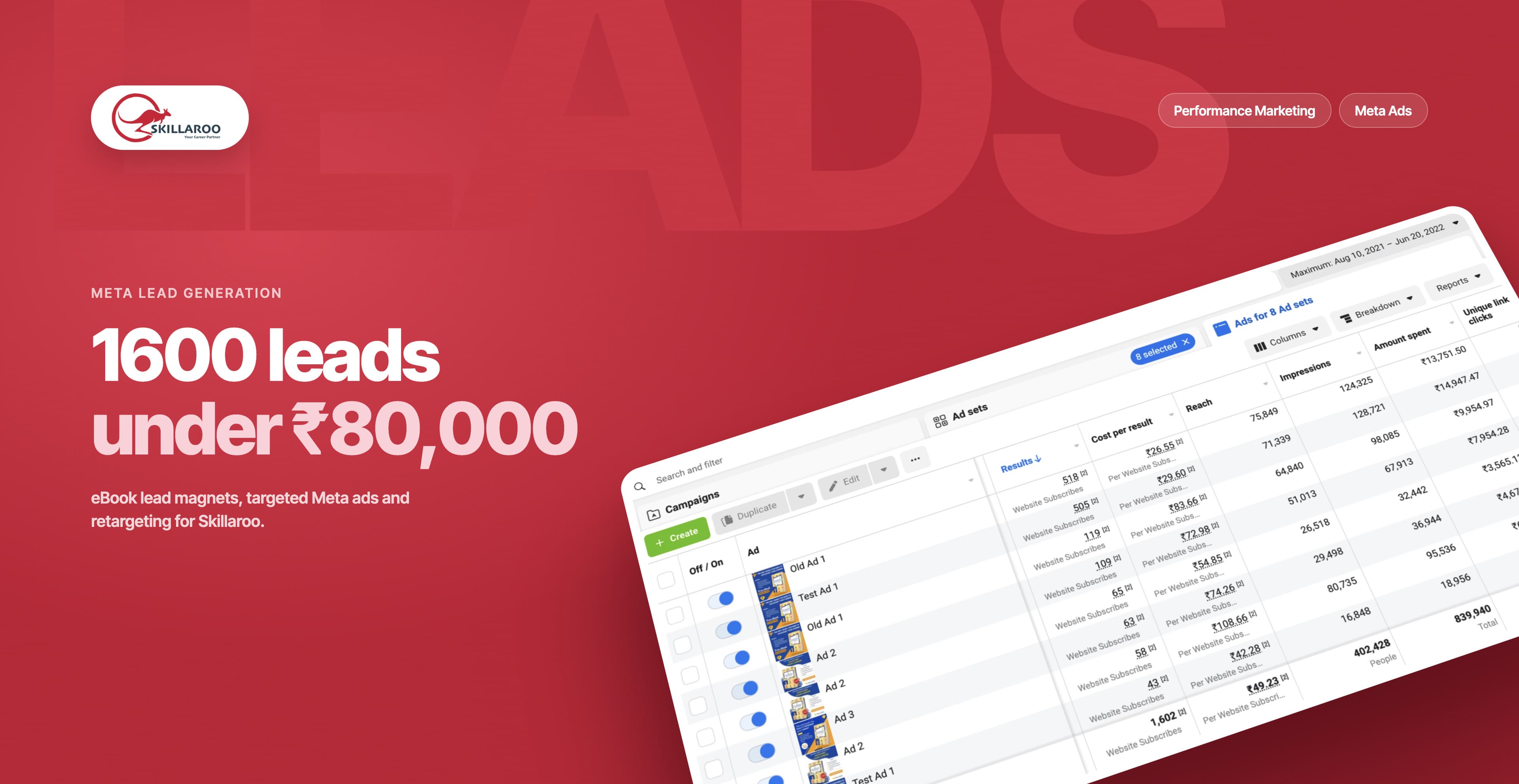



























































EdTech marketing in India is a unit-economics category. The difference between a profitable online learning business and a failed one is usually not the course - it's cost-per-lead and lead-to-enrollment conversion. Post-BYJU's collapse and the 2023-2024 sector reset, investors and operators are sober about CAC discipline in ways they weren't during the ZIRP era. Baclinc's proof in this category: we ran lead generation for Skillaroo and delivered 1,600 leads on an ₹80,000 budget via eBook lead magnets - roughly ₹50 per lead, in a category where ₹200-500 per lead is typical. The playbook - high-utility lead magnet, Meta + Google intent-matched targeting, UTM-disciplined attribution, and a lead-nurture sequence that respects the 30-90 day consideration window Indian learners actually use - ports to test prep, skill-upgrade courses, K - 12 supplementary, professional certifications and vernacular-language learning.
Indian EdTech operates in 5 broad segments with different economics. Test prep (JEE/NEET/UPSC/CAT/GATE/bank exams): CPL ₹150-400, conversion to paid 3-8%, AOV ₹15k - ₹1L+, long decision window (3-9 months). K - 12 supplementary (tutoring, curriculum help): CPL ₹200-500, conversion 2-5%, AOV ₹8k - ₹40k annually, shorter decision (1-4 weeks). Skill upskilling (tech, finance, marketing): CPL ₹100-300, conversion 5-12%, AOV ₹5k - ₹50k, 2-6 week window. Professional certification (PMP, CFA, ACCA, AWS): CPL ₹300-800, conversion 8-18%, AOV ₹20k - ₹1.5L, 1-3 month window. Vernacular-language learning (spoken English, digital skills in Hindi/regional): CPL ₹50-200, conversion 5-15%, AOV ₹1k - ₹15k, very short window (days to 2 weeks). Channel mix skews differently by segment: test prep leans heavy Google search + YouTube (students actively search); K - 12 leans Meta + parent-targeted LinkedIn; skill upskilling works on Meta + LinkedIn + YouTube; certifications lean heavy Google + LinkedIn; vernacular skews Meta lookalike + SMS. The lead magnet economics are the core lever across all segments - Skillaroo's eBook-led funnel hit ₹50/lead because the magnet matched learner intent precisely (roadmap PDF for a specific career skill path), the audience was narrowly matched to that intent, and the creative communicated the magnet's utility in under 3 seconds. Where most EdTech marketing fails: magnet is too generic (saves cost per download but doesn't qualify), audience is too broad (Meta lookalikes without seed cohort of paid buyers), attribution is hazy (last-click dashboards instead of cohort analytics), nurture is absent (lead goes cold in 72 hours), and vernacular is ignored despite being the cheapest CPL.