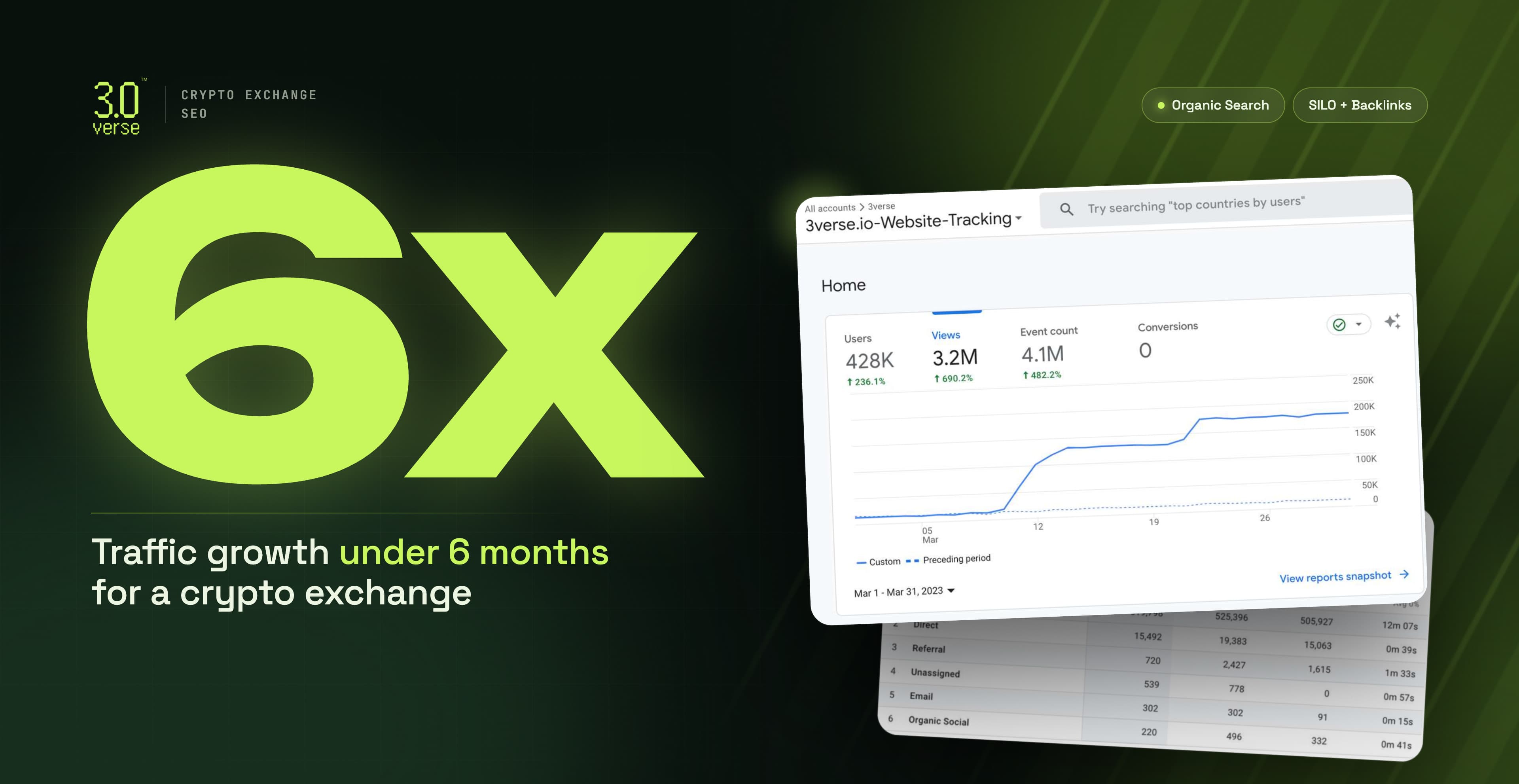


























































Marketing a crypto or Web3 product in India runs into two realities most growth agencies don't understand. First, the policy surface - FIU-IND registration, ASCI's crypto-ad guardrails, the 30% VDA tax and 1% TDS - narrows the channel mix in ways that would break a standard D2C playbook. Second, the audience is on Twitter/X, Telegram and Discord, not Instagram Reels, and searches for 'how to stake ETH' on Brave or ChatGPT before it searches on Google. Baclinc runs this stack for 3.0 Verse, a crypto exchange we helped drive 6× organic traffic in 6 months across the main domain plus 5 connected entities - editorial, research, tokens and learn properties - by treating every sub-domain as its own ranking asset and wiring them into a single topical graph. We're a Mumbai-based full-service agency (founded 2017 by Shalmali Parkar and Abhishek Yadav, 25+ team, 150+ clients, ₹50Cr+ in ad spend managed). For crypto and Web3 we lead with SEO + AEO + community rather than paid acquisition, because the paid-ad surface for this category is structurally small and getting smaller.
India's crypto and Web3 sector sits in an unusually constrained regulatory environment. FIU-IND (Financial Intelligence Unit India) now requires VASP registration for exchanges and custodians under PMLA, with heavy penalties for non-compliance. The 30% VDA tax plus 1% TDS on every trade applies since April 2022 and shapes user behaviour meaningfully - most Indian traders rebalance less frequently, which changes retention and revenue mechanics for exchanges. ASCI (Advertising Standards Council of India) mandates risk disclaimers on every crypto ad - 'Crypto products and NFTs are unregulated and can be highly risky' - failing which ads get pulled and the brand faces reputational damage. The real market in India is a mix of centralized exchanges (CoinDCX, WazirX, CoinSwitch Kuber, Mudrex, Unocoin), Layer-2 and infra protocols (Polygon is the flagship), Web3 funds (Woodstock, Arka Ventures), Indian DAO projects, NFT marketplaces on the decline, and a growing crop of wallet and DeFi apps. The channel reality looks nothing like D2C. Twitter/X is the primary community and discovery surface - threads, Spaces and builder-focused conversations convert harder than any paid ad. Telegram and Discord are where high-intent users land after a tweet and where actual wallet-connections happen. Long-form research reports (Messari-style) drive institutional interest and citations. SEO is achievable but slow - Google rates crypto YMYL, so E-E-A-T at the author level, schema markup and a clean editorial graph matter more than keyword density. Paid ads are structurally narrow: Google blocks most crypto retail advertising, Meta requires prior authorisation and caps reach, Twitter/X Ads is the most usable but needs compliance-reviewed creative. AEO - being the source cited by ChatGPT, Claude, Perplexity and Brave's AI - is an outsized growth lever for Web3 because the next user cohort overwhelmingly asks an LLM first. Our 3.0 Verse engagement taught us the specific unlocks: treating every sub-property (editorial, research, token pages, learn section) as its own ranking asset, then wiring them into a single topical graph via internal linking; investing in author-level E-E-A-T (team pages with verifiable credentials, LinkedIn, prior publications); and structuring FAQ and HowTo pages explicitly for LLM extraction.