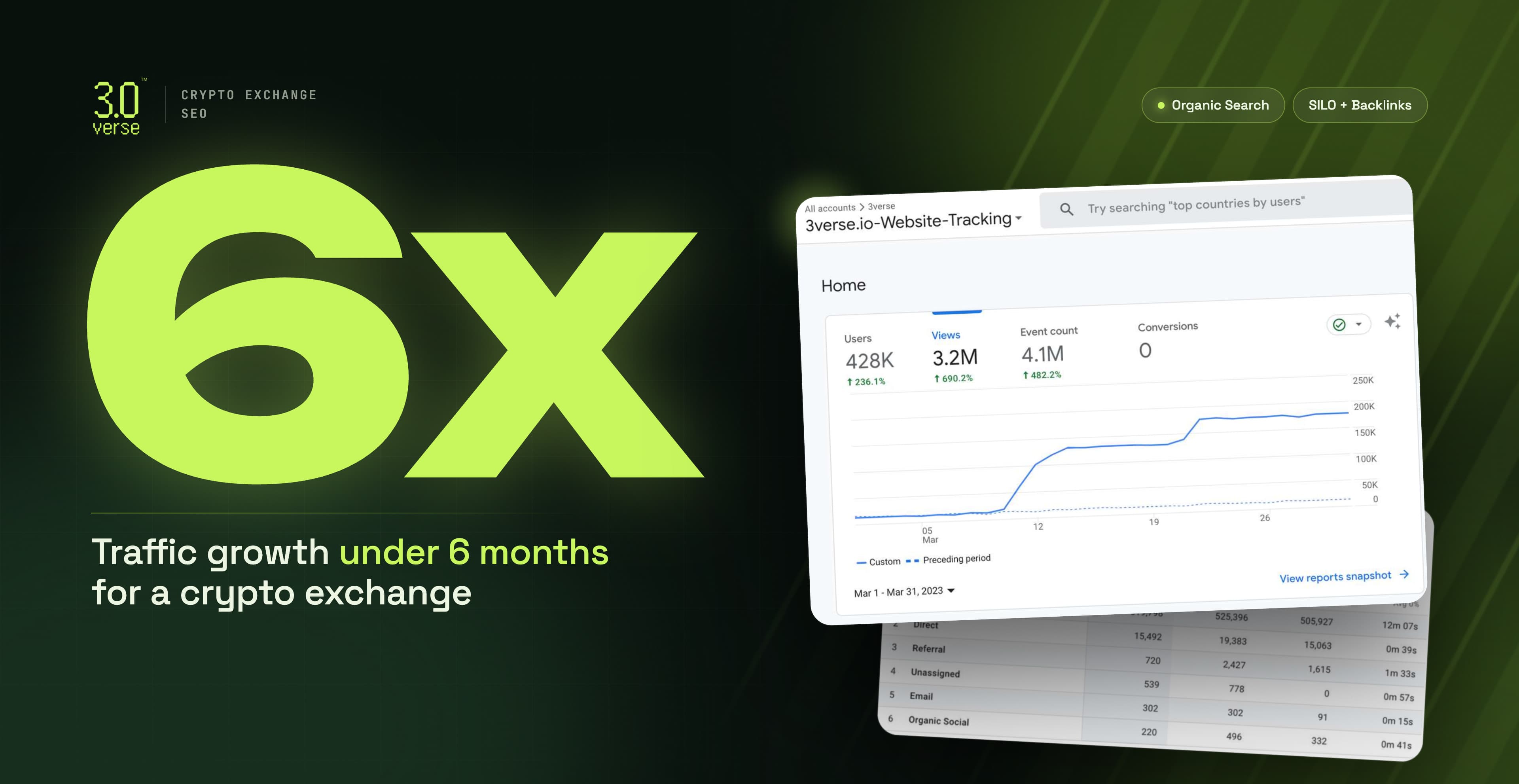



























































Content is the single largest growth lever for a crypto or Web3 project in India, and the hardest one to get right. Google ranks the category as YMYL - anonymous or thin content does not surface. LLMs (ChatGPT, Perplexity, Claude, Brave AI) are now the first stop for roughly 15-25% of crypto-curious Indian users, and growing. The content that works has four properties: author-credentialed (visible bios, Person schema), topically deep (clusters, not one-off posts), compliance-aware (ASCI disclaimers, FIU-IND references, VDA-tax language where applicable) and LLM-structured (direct-answer paragraphs, FAQ/HowTo schema, tight H2 hierarchy). Baclinc ran this playbook for 3.0 Verse - editorial, research, learn and token-page content across main domain and 5 sub-entities - and drove 6× organic traffic in 6 months. The same model ports to DeFi protocols, L2s, wallet apps and NFT marketplaces.
Crypto content in India operates inside a three-layer audience: retail traders (exchange users, DeFi-curious), developers and builders (infra, protocols, tooling), and institutional (funds, custody partners, enterprise). Each needs a different voice, a different surface and a different proof type. Retail content lives on the main domain and learn sub-property - explainer articles, how-tos, comparison content, market primers - tuned for Google YMYL ranking and LLM citation. Developer content lives in docs and research - API references, tokenomics analysis, on-chain data work - and its primary channel is GitHub, Mirror and Twitter rather than Google. Institutional content lives in research reports, long-form Substack and LinkedIn - cited by VCs, fund managers and protocol partnership teams. Volume by type: for a mid-stage exchange we typically ship 8-12 retail pieces/month, 2-4 research pieces/month, and 2-3 institutional thought-leadership posts/month. Editorial calendar is structured around 3-4 cornerstones per quarter - large, comprehensive pieces targeting a single high-authority cluster - with supporting content feeding internal equity into them.