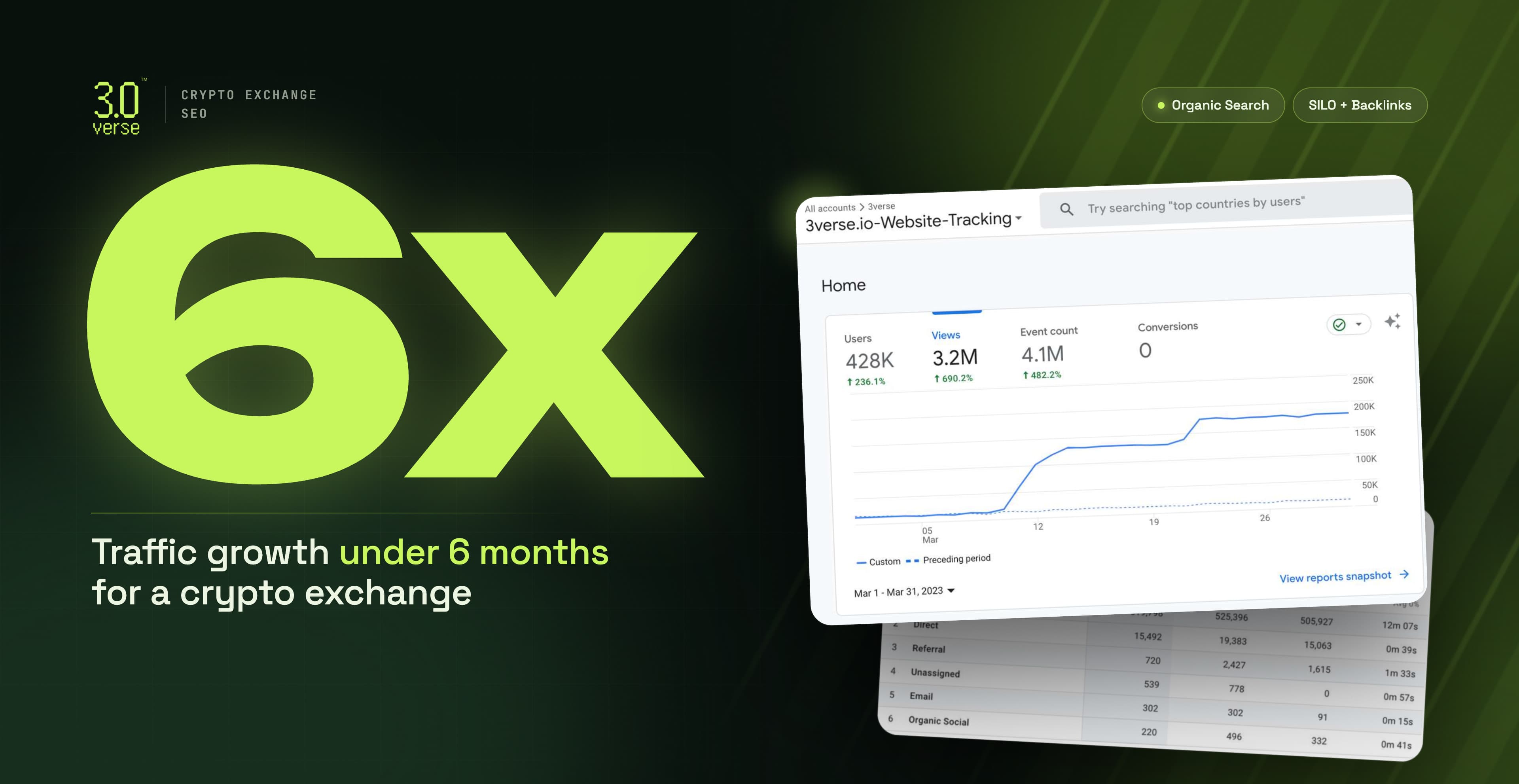

























































SEO for a crypto or Web3 project isn't a sub-discipline of standard SaaS SEO - it operates inside Google's YMYL (Your Money, Your Life) framework, which means E-E-A-T (Experience, Expertise, Authoritativeness, Trust) isn't a nice-to-have, it's the single biggest ranking signal. We helped 3.0 Verse drive 6× organic traffic in 6 months across its main domain and 5 connected sub-entities - research, learn, editorial, tokens, tools - by treating each sub-property as an independent ranking asset wired into one topical graph. That's the approach we bring to exchanges, Layer-2 protocols, DeFi apps and NFT marketplaces: author-level credentialing, sub-property topical authority, compliance-aware content, and AEO structuring so the same pages get cited by ChatGPT, Perplexity and Brave AI.
Google treats crypto and Web3 content as YMYL - the same bar applied to medical, financial and legal content. That has three consequences. One: author credibility is the dominant signal. Anonymous or ghost-authored content does not rank, no matter how good the writing; verifiable team pages with LinkedIn, prior publications and Person schema are non-negotiable. Two: commercial pages (buy page, staking page, exchange page) rank slower than informational pages (what is, how to, explainer). The SEO engine builds informational authority first, then passes internal equity to commercial pages. Three: sub-property strategy - whether your research, learn, docs and blog live on the main domain or sub-domains - is a first-order decision. For 3.0 Verse, moving research and learn to sub-domains (research. and learn.) while keeping docs on the main domain unlocked the 6× gain because each sub-property built its own topical authority without diluting the commercial pages. AEO layers on top: roughly 15-25% of crypto-curious Indian users now ask ChatGPT, Perplexity or Brave AI before Google, and that share is growing quarterly. Structuring every cornerstone page for LLM extraction - a 50-70 word direct-answer paragraph at the top, FAQ and HowTo schema, numbered sub-sections, tight factual phrasing - compounds search volume and reduces dependency on Google alone.